 Selecciona un país ▼
 GuruSoft
 Ecuador
 Colombia
 Bolivia
 Panamá
 R. Dominicana
 Costa Rica
 Paraguay
 Perú
Perú Guatemala
 El Salvador
 España
 Francia
 Angola
Online e-invoicing? You can find it here, at GuruSoft!

ELECTRONIC INVOICING
How does electronic invoicing work?
Tax Documents:
The issuer must retain the files in XML format of the certified DTEs for up to a period of 7 years.














High transactionality and availability of our services.
We have a high availability and disaster recovery scheme in our Amazon Web Services private cloud, giving our customers assurance that their billing process will not be affected at response time.

New Regime of Online Electronic Invoice
The New Online Electronic Invoicing Regime (Board of Directors Agreement Number SAT-13-2018) is an operating model and the rules applicable to online electronic invoicing of the Republic of Guatemala was published in the Official Gazette on May 2, 2018 and enters into force on May 23, 2018, likewise, Agreement 26-2019 contains the amendments to Agreement 13-2018, was published in the Diario de C.A. on November 27, 2019.
Superintendence Resolution Number SAT-DSI-838-2019 published in the Diario de Centro América on September 11, 2019 requires the incorporation of new actors in the Public Sector into the Online Electronic Invoice Regime-FEL- such as:
- State Agencies.
- Decentralized and autonomous entities including Municipalities.
- Companies whose capital is made up of contributions from the State,
- Non-profit entities that receive, administer, or execute public funds
- Entities that have State contributions as a source of income.
- Trusts constituted with public and social funds.
- Entities established in Article 1 of Decree No. 57-92 of the Congress of the Republic of Guatemala.
Latest resolutions:
Board of Directors Agreement Number SAT-13-2018 Online Electronic Invoicing Regime (FEL)
Board of Directors Agreement Number SAT-26-2019 Reforms to the Online Electronic Invoicing Regime (FEL)
Board of Directors Agreement Number 15-2020 Reforms to the Online Electronic Invoicing Regime (FEL)
Our solutions
for your business
Integration for
SAP Business One
The eDoc AddOn is an add-on for SAP Business One, which extends the functionality of the system by adding screens, buttons and validations, which allow electronic documents to be issued and received without altering the business logic. All without leaving the screens of SAP BUSINESS ONE!
Integration for
SAP R3, ECC, S/4
Native integration for SAP R3 allows you to issue and receive electronic documents.
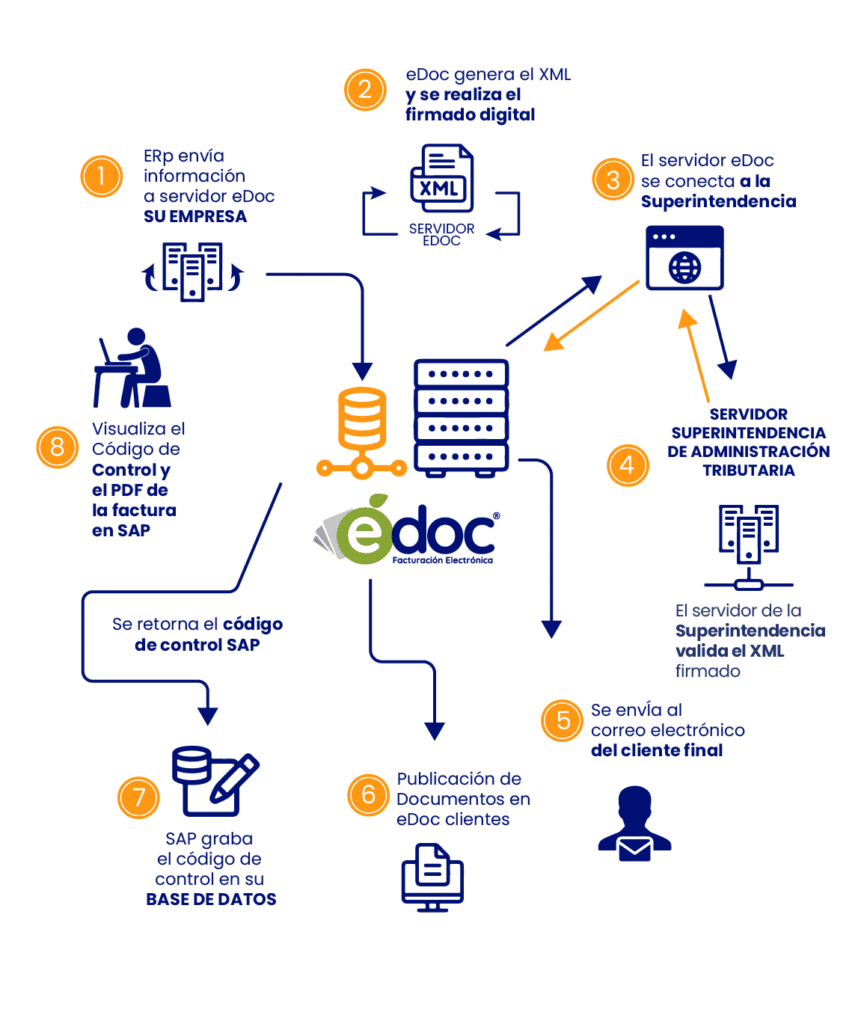
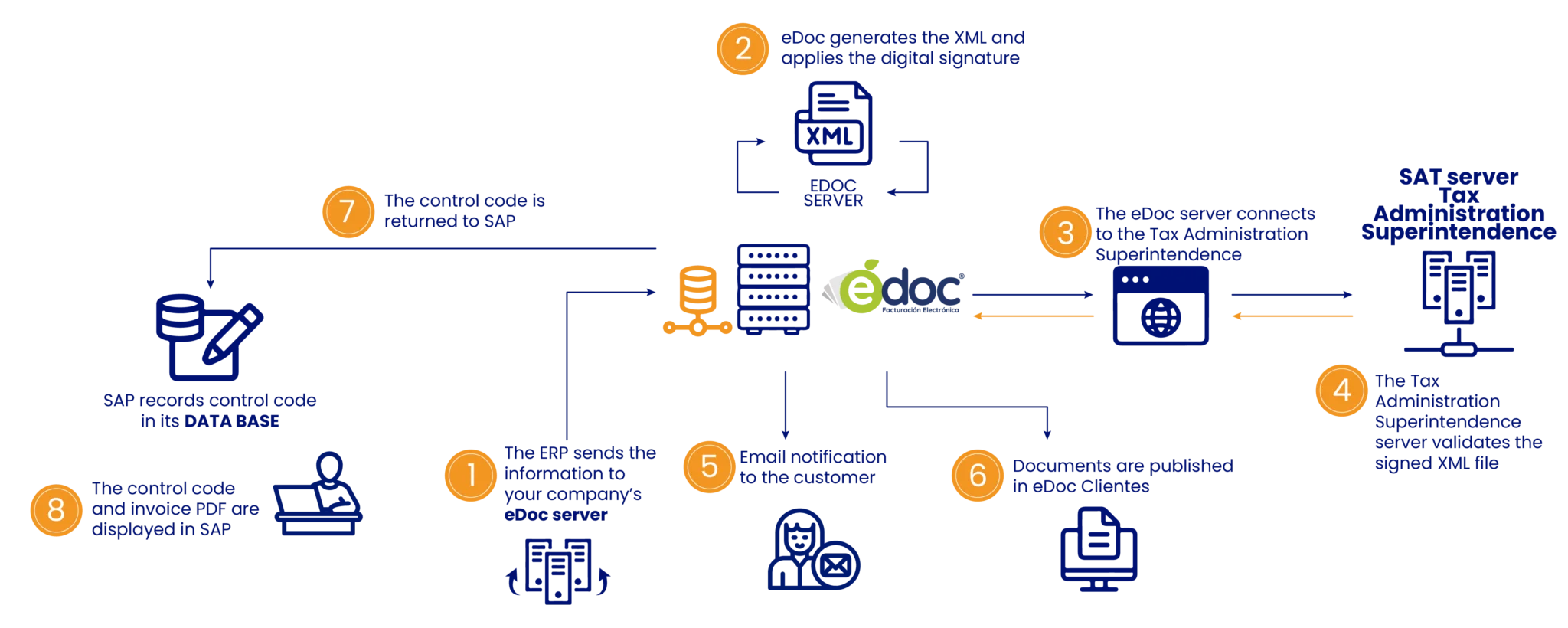
Our solution is composed of a connector that is responsible for sending the information from the ERP to the eDoc server hosted in the cloud, it is responsible for validating the veracity of the information to later create the XML, once created it is signed and the code is assigned and sent to the SAT for final validation.
Integrations on
Other ERPs or invocing
We know the complexity of implementing electronic invoicing in large and medium-sized companies throughout Latin and Central America, which has allowed us to develop a very stable product, where integration to your ERP is simple and implementation is fast.
Integration with
Point of sale
The integration of the service makes it possible to detect the electronic documents that arrive at the ERP from the point of sale and then send them for their respective authorization, allowing the automation of the process so that the user does not have to manually resend each document to the tax entity. In addition, depending on the integration that is proposed, the consecutive and other data must be mapped to send them correctly to the tax entity, as well as validations on the information that comes from the point of sale.
Frequently asked questions
It is a new modality for taxpayers to issue invoices and other electronic tax documents (DTE) securely and with authorization online.
- The taxpayer issues the document with an electronic signature and it is sent to the certifier automatically
- The certifier receives, validates and authorizes each document and it is automatically sent to the issuer and the SAT.
- The sender delivers it to the receiver.
- The SAT verifies each electronic tax document and makes it available to the issuer and receiver for consultation and verification.
-
All taxpayers who issue invoices or other tax documents, being enabled in two ways:
- Mandatory, to whom the SAT notifies.
- Voluntary, those who wish to do so without being notified.
*Articles 11 and 12 of Board of Directors Agreement 13-2018.
Through the option “Enable yourself as an issuer”, available at Virtual Agency/Online Electronic Invoicing (FEL).
- Easy authorization through the SAT Virtual Agency.
- Immediate authorization of each document.
- Reliability of information
- Reduced use of paper and other resources.
- Verification of the validity of electronic invoices received through the SAT Portal.
- Consultation of electronic invoices issued/received in the Virtual Agency.
- Taxpayers will be able to continue operating under that regime while they migrate to the Online Electronic Invoicing (FEL) regime.
