 Select a country ▼
 GuruSoft
 Ecuador
 Colombia
 Bolivia
 Panama
 Dominican Republic
 Costa Rica
 Paraguay
 Peru
Peru Guatemala
 El Salvador
 Spain
Spain France
 Angola
Electronic invoicing?
¡GuruSoft!


Fill out this form to provide you with information about our Electronic Invoicing services
ELECTRONIC INVOICING
How does electronic invoicing work?
Tax Documents:
The issuer must retain the files in XML format of the certified DTEs for up to a period of 7 years.
Standard invoice
Export invoice
Contingency invoice
Electronic Debit Note
Electronic Credit Note
High transactionality and availability of our services.
We have a high availability and disaster recovery scheme in our Amazon Web Services private cloud, giving our customers assurance that their billing process will not be affected at response time.

In 2010, the use of electronic invoicing began in Peru, the Resolution of LAW No. 188-2010/SUNAT of 2010 established the Electronic Invoice Issuance System (SEE).
From the Superintendence Resolution No. 000221-2020/SUNAT of December 23, 2020, the provisions in the regulations on electronic issuance were relaxed, postponing the designation of new electronic issuers. Therefore, the new taxpayers obliged to issue electronic payment vouchers are those taxpayers according to annual income that as of December 31:
- They generated annual income greater than or equal to 75 UIT (315000 soles). Maximum date: 1/01/21.
- They generated annual income equal to or greater than 23 UIT (96600 soles) and less than 75 UIT (315000 soles). Maximum date: 01/09/2021.
- They generated annual income of less than 23 UIT (96600 soles). Maximum date: 1/01/22.
Latest resolutions:
Superintendence Resolution No. 000221-2020/SUNAT:
Provisions in the regulations on electronic issuance are relaxed.
Published December 23, 2020.
Superintendence Resolution No. 000193-2020/SUNAT:
They modify the regulations on electronic issuance in relation to electronic invoicing.
Published November 7, 2020.
Superintendence Resolution No. 000191-2020/SUNAT:
They postpone the designation of electronic issuers.
Published October 31, 2020.
Our Solutions
Integration for
SAP Business One
The eDoc AddOn is a complement for SAP Business One that extends the system’s functionality by adding screens, buttons, and validations, allowing electronic documents to be issued and received without altering business logic. All without leaving the SAP BUSINESS ONE screens!
Integration for
Integration
Native integration for SAP R3 allows you to issue and receive electronic documents.
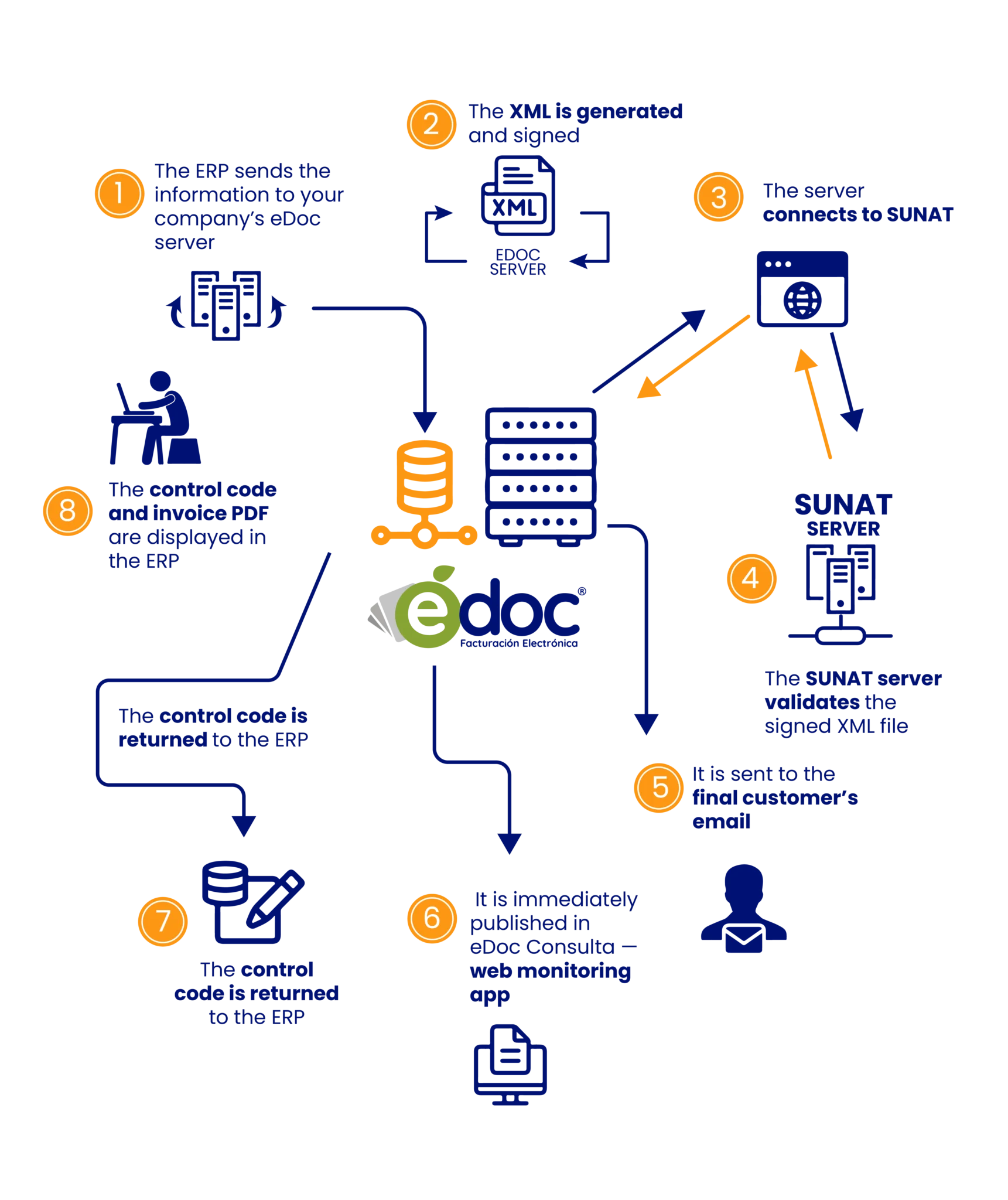
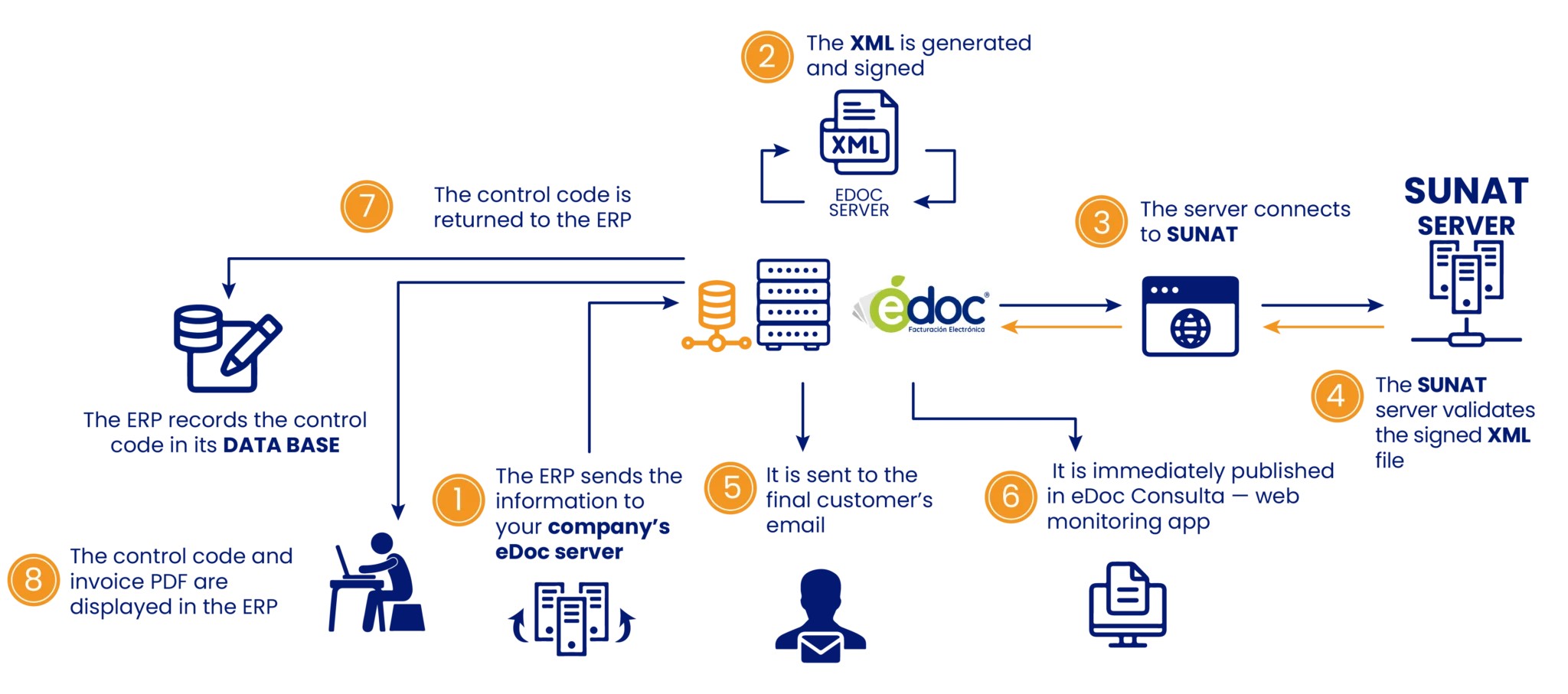
Our solution is composed of a connector that is responsible for sending the information from the ERP to the eDoc server hosted in the cloud, it is responsible for validating the veracity of the information to later create the XML, once created it is signed and the code is assigned and sent to SUNAT for final validation.
Integrations with
Other ERPs or invocing systems
We know the complexity of implementing electronic invoicing in large and medium-sized companies throughout Latin and Central America, which has allowed us to develop a very stable product, where integration to your ERP is simple and implementation is fast.
Integration with
Point of sale
The integration of the service makes it possible to detect the electronic documents that arrive at the ERP from the point of sale and then send them for their respective authorization, allowing the automation of the process so that the user does not have to manually resend each document to the tax entity. In addition, depending on the integration that is proposed, the consecutive and other data must be mapped to send them correctly to the tax entity, as well as validations on the information that comes from the point of sale.
Frequently Asked Questions
It is the type of proof of payment called INVOICE, issued through the electronic issuance system developed from the taxpayer’s systems. Through the Electronic Issuance System from the systems developed by the taxpayer, the Debit and Credit Notes linked to the Electronic Invoice are also issued from the Taxpayer.
To distinguish physical payment receipts from electronic ones, a new series structure has been established.
- Physical Receipts: Numerical Series
- Electronic Receipts: Alphanumeric Series
The electronic documents that must be sent to SUNAT are:
- Invoices and their associated electronic credit and debit memos
- Daily summary of sales receipts and their credit and debit notes
- Cancellation Communication
a) Names and surnames, denomination or company name
b) If it is a natural person, it must also contain the number of the identity document. If it is a legal entity, it must contain the RUC of the company.
c) Have a medium level of security
The Digital Certificate is used to digitally sign electronic payment receipts (invoices, sales receipts, and credit and debit notes) as well as daily summaries and cancellation communications.
In this way, the taxpayer, when digitally signing payment vouchers and other electronic documents, cannot subsequently ignore the authorship of these documents, thereby generating security in the commercial transaction.
a) Names and surnames, denomination or company name
b) If it is a natural person, it must also contain the number of the identity document. If it is a legal entity, it must contain the RUC of the company.
c) Have a medium level of security
