 Selecciona un país ▼
 GuruSoft
 Ecuador
 Colombia
 Bolivia
 Panamá
 R. Dominicana
 Costa Rica
 Paraguay
 Perú
Perú Guatemala
 El Salvador
 España
 Francia
 Angola
Our Electronic Invoicing system is the favorite of large companies in the DR

Fill out the following form and learn about our Electronic Invoicing services.
Why choose
invoice in a manner
electronics?
- Electronic Invoicing for individuals
- Human errors decrease
- Complies with current regulations
- Contributes to the care of the environment
- Simplify all billing
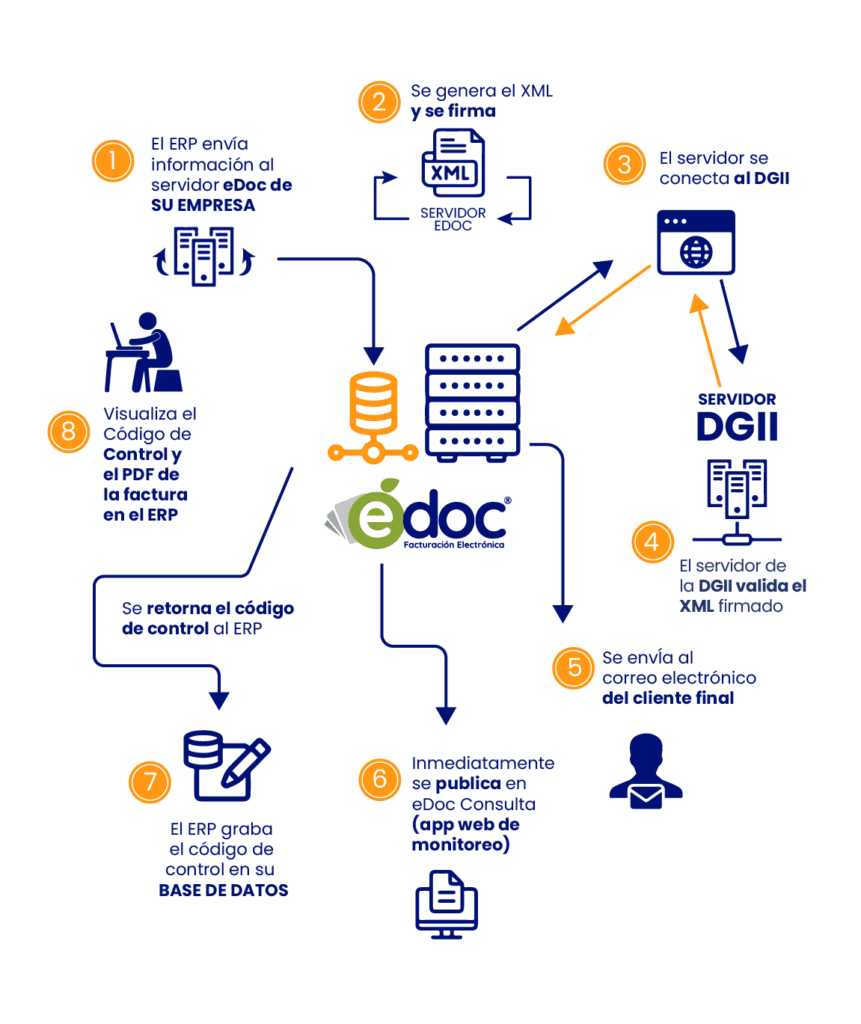
How does Electronic Invoicing work?
in the Dominican Republic?
Types of Electronic Tax Receipts (e-CF)
We offer you:
- Security in your data
-
Scalability with your
Business
-
High level of
Transactionality
Our eDoc software is duly approved under the General Standard 01-20 resolution
The Electronic Invoicing system in the Dominican Republic is determined based on the following legal framework:
- Decree 254-06: for the regulation of the printing, issuance and delivery of Electronic Tax Receipts (e-CF).
- General Rule 06-18: on Tax Receipts.
- General Rule 05-19: on types of Special Tax Receipts.
- Norma General 01-20: que regula la emisión y el uso de los Comprobantes Fiscales Electrónicos (e-CF)
- Resolución Núm. 035-2020, que Dicta la Norma de Aplicación de la Ley Núm. 126-02 Sobre Comercio Electrónico, Documentos y Firmas Digitales a los Procedimientos Tributarios.
- General Standard 01-2020, which regulates the issuance and use of Electronic Tax Receipts (e-CF) in the Electronic Invoicing process.
- Aviso 24-19, sobre la Estructura y Tipos de Comprobantes Fiscales Electrónicos (e-CF).
- General Rule 05-19, on Types of Special Tax Receipts.
Our Solutions
Integration for
SAP Business One
Our eDoc AddOn is an add-on for SAP Business One and is SA certified. It extends the functionality of the system, adding screens, buttons and validations, to issue and receive documents, without altering the logic of your business.
Best of all, you can perform your processes without the need to leave your ERP windows.
Integration for
SAP R3, ECC, S/4
The native integration with these ERPs allows you to issue and receive electronic documents quickly and efficiently. Our solution includes a connector that sends the information from the ERP to the eDoc server, which is hosted in the cloud.
The server validates the accuracy of the information and then creates the XML file. Once created, it is signed and sent to the DGII for its respective validation and approval.
Our solution adapts to architecture models with PI/PO, SOAP, HCL, CPT interfaces and other integration buses.
Integrations with
other ERPs or invoicing systems
Our Electronic Invoicing solution is easily integrated into any ERP, such as Microsoft Dynamics, Oracle, Peachtree, SAGE, Quickbooks, among others, either through web services, flat files or databases, ensuring that the operation of the software is optimal and enhances invoicing processes.
eDoc Reception
Reviewing supplier invoices, one by one, can become a headache for the team in charge of doing it.
With this in mind, we have designed eDoc Reception, a function that will allow you to automatically validate each invoice from your suppliers, without the need for manual intervention.
Here you will gain not only time, but also accuracy and productivity, so that you dedicate more space to strategy
Integration with
Point of sale
The integration of this service will allow you to validate and transform all the documents issued from your point of sale to an XML built under the structure of the DGII and will be sent for their respective authorization, automating the process so that the user does not have to manually send each document to the tax entity.
The integration can be done directly by mapping data to eDoc Web Services or through an automatic processing service in your ERP or Billing System. That’s how practical!
Frequently asked questions
An electronic tax receipt shall be understood as a digitally signed electronic document that certifies the transfer of goods, delivery in use or the provision of services, and must always comply with the requirements established in Decree No. 254-06.
- Reduced printing and paper acquisition costs.
- Positive impact on the environment.
- Reduced physical document storage costs.
- Reduced cost of compliance.
- Faster and more efficient administrative processes.
- Optimization of time and resources.
- Process automation.
- Facilitates tax compliance.
- Facilitates e-commerce
- It encourages fair competition and fairness.
- It provides legal certainty to both the sender and receiver of the
- Tax receipt.
- Traceability and certainty of information
- No more document loss.
- Standardize electronic business relationships between companies.
- Greater security in the safeguarding of documents.
Electronic invoicing promotes fair competition among economic agents, modernizes and streamlines processes, while facilitating tax compliance and reducing transactional and operational costs.
- It has the same validity and legal effects as the paper invoice.
- Electron is emitted
- Standard Invoice Format (.xml).
- It is digitally signed.
- Offers greater security and integrity of information
Unlike the non-electronic tax receipt, the electronic tax receipt (e-CF) has the following characteristics:
- It is issued electronically.
- Standard Invoice Format (.xml).
- Digitally signed by digital certificate.
- Greater security and integrity of information (non-repudiation).
However, the e-CF has the same validity and legal effects as the paper invoice and must comply with the provisions of Decree 254-06 and according to the specifications of General Standard 06-2018 on Tax Receipts.
